
Travel · New Zealand
The Castle at the Edge of the World
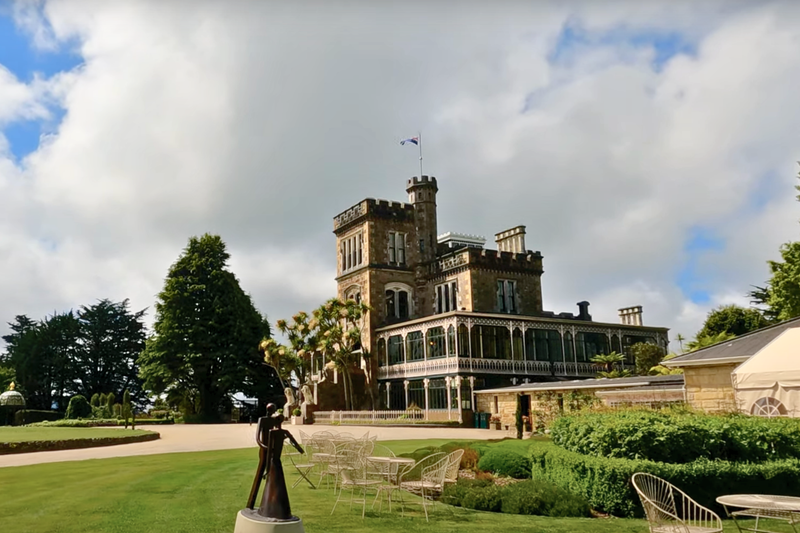
New Zealand has only one castle. It was built by a gold-rush millionaire, haunted by grief, and saved by a family who refused to let it die.
A Man and His Monument
William James Mackinnon Larnach arrived in Otago in the 1860s riding the momentum of the gold rush. He was a banker, a businessman, a politician — the kind of man who measured success in column inches and column widths both. In 1871, he commissioned a building that had no functional reason to exist: a full castle, with turrets, a great hall, and a ballroom that could embarrass any establishment in Edinburgh.
It took 200 workers three years just to finish the main structure. The ballroom ceiling alone — a riot of carved plasterwork — consumed another twelve years of craftsmen’s lives. Marble was imported. Tiles came from England. Larnach wasn’t building a home. He was building a statement.
The Grief Inside the Stone
What the brochures don’t linger on is what happened next. Larnach’s first wife, Eliza, died in 1880. He remarried, and that wife died too. His third marriage — to a woman 33 years his junior — ended in scandal when she ran off with his son from the first marriage. In 1898, Larnach walked into a committee room of the New Zealand Parliament and shot himself.
The castle passed through various hands, briefly became a mental asylum, then a tourist attraction with a corrugated iron roof that would have made its builder weep. By the mid-20th century, it was a ruin in all but name.
Quick Facts
- Built 1871–1887
- Location Camp Road, Otago Peninsula, Dunedin
- Status Category I Heritage Building (NZ)
- Open Daily — gardens & castle tours
- Accommodation On-site lodge with 12 rooms
- Closest airport Dunedin International — ~35 min drive
The Barkers Saved It
In 1967, Barry and Margaret Barker bought the wreck for next to nothing and began a restoration project that their grandchildren are still continuing today. Margaret Barker became the castle’s self-appointed historian, archivist, and evangelist. Her memoir, Castle Story, reads like a love letter written to a building that kept trying to fall down.
The work was unglamorous — scraping off decades of paint, sourcing period-accurate wallpaper, replanting the formal gardens from scratch. But room by room, floor by floor, Larnach Castle came back. Today it stands as one of the finest examples of Victorian interior craftsmanship in the Southern Hemisphere. The ballroom ceiling, restored to its original ivory and gold, is worth the drive from anywhere.
What You Actually Experience
Visitors arrive through gates flanked by stone lions and walk up a driveway that was clearly designed to make you feel slightly inadequate. The gardens — 35 acres of them — sweep down toward the harbour, planted with species from across the British Empire: the kind of botanical promiscuity that only a certain type of Victorian could get away with.
Inside, the castle is dense with detail. Kauri wood staircases. Dutch stained glass. A servant’s bell system that still maps, precisely, the domestic geography of 1880s power. The tower, reached by a tight spiral stair, gives you a view across the Otago Harbour and out toward the open Pacific — on clear days, you can watch albatross riding the thermals off Taiaroa Head, less than ten kilometres away.
For those who want more than a day visit, the on-site lodge offers twelve rooms, each named for a New Zealand bird, each different. Breakfast arrives with local produce and a view that costs nothing extra.
Getting There & When to Go
The Otago Peninsula road hugs the shoreline south of Dunedin — the drive itself is reason enough to come. Rental cars are the easiest option; taxis and rideshares operate from the city. Summer (December–February) brings longer days and better weather, but autumn and winter have their own argument: mist rolling in off the harbour, the gardens quieter, the castle more authentically itself.
Larnach Castle is not Versailles. It will not overwhelm you with scale. What it does instead is rarer — it tells a specific human story, in a specific place, through objects and rooms that have survived long enough to mean something. That is, when you think about it, exactly what a castle should do.
Leave a Reply